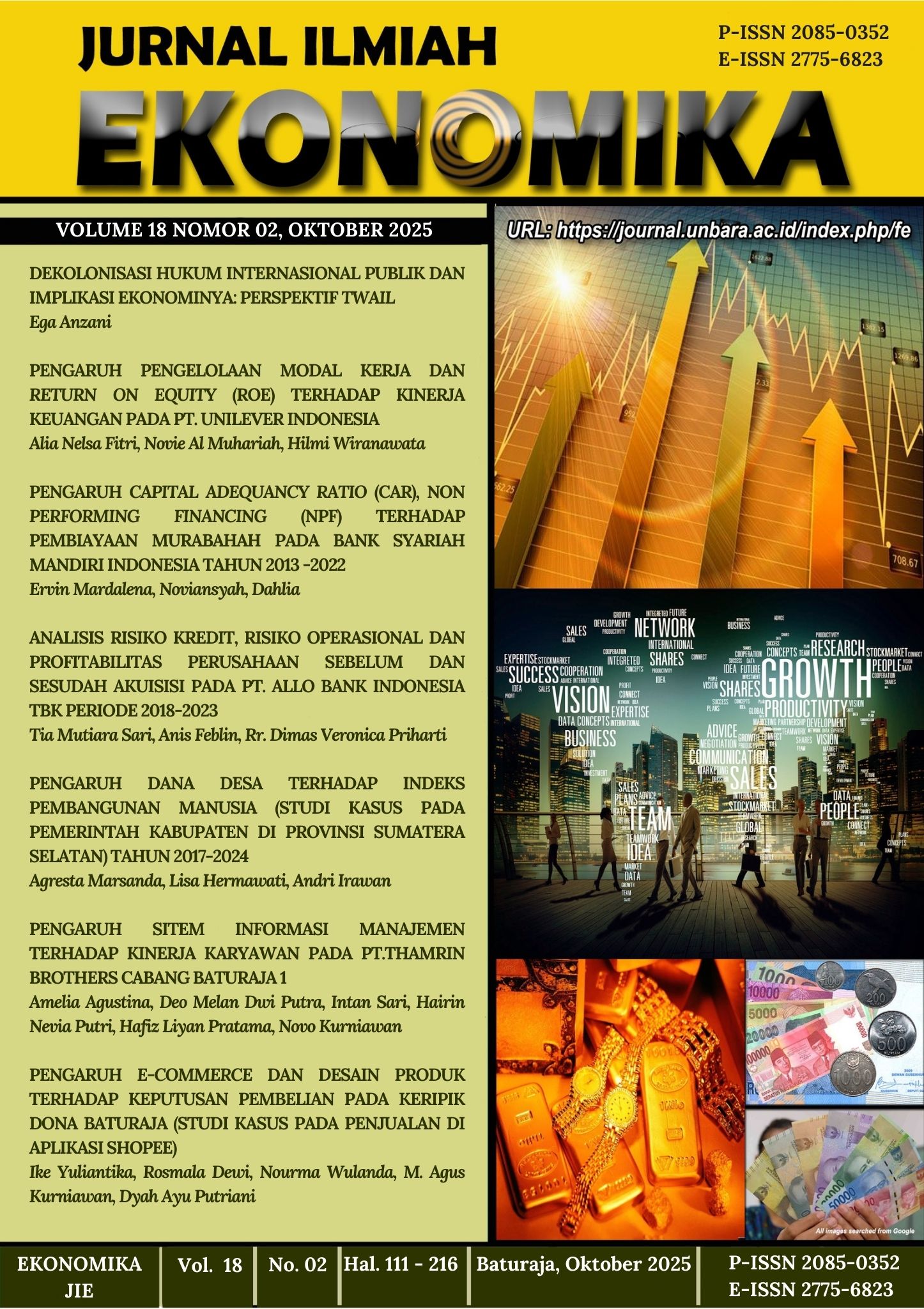
DEKOLONISASI HUKUM INTERNASIONAL PUBLIK DAN IMPLIKASI EKONOMINYA: PERSPEKTIF TWAIL
DOI:
https://doi.org/10.54895/4e3yxp82Abstract
This article analyzes the decolonization of public international law from the perspective of the Third World Approach to International Law (TWAIL), emphasizing its implications for the global economic structure. Using a qualitative normative research method with a conceptual and historical approach, this study examines how the colonial legacy embedded in international law continues to shape global economic inequality. Data was collected through a review of TWAIL scholarship, international law doctrine, and studies on global political economy.
The analysis shows that international law, while formally neutral, reinforces the economic hierarchy between the Global North and Global South through trade regimes, investment protection standards, and global financial governance. TWAIL offers an alternative framework for reforming international law to support economic justice, strengthen state sovereignty, and expand policy space for development for Global South countries. This article argues that the decolonization of international law is essential for building a more equitable global economic order and highlights the relevance of TWAIL to contemporary debates on development and global inequality.
Downloads
Published
Issue
Section
License
Copyright (c) 2025 Ega Anzani

This work is licensed under a Creative Commons Attribution 4.0 International License.